
Share article
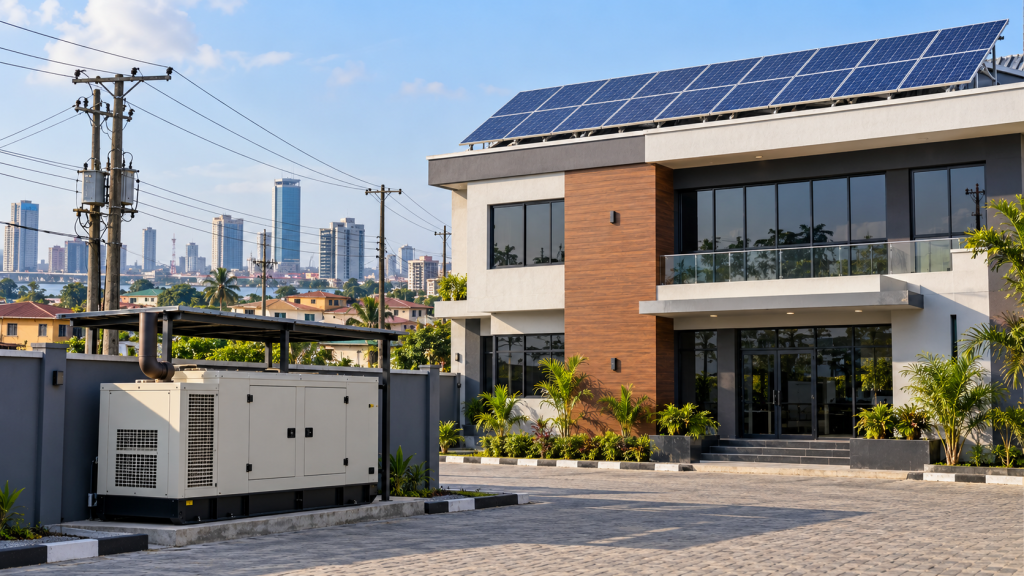
How much are you really paying for electricity, and could solar energy save you money? We compare grid electricity, diesel generators and solar power using practical Nigerian examples for homes, businesses and industries.
What if Your Electricity Expenses Could Become an Investment?
Imagine running a business in Nigeria that consumes 1,000 litres of diesel every month.
At the benchmark diesel price of ₦1,790.25 per litre recorded on 19 October 2026, that business would be spending approximately ₦1.79 million monthly—or ₦21.48 million annually—on diesel alone.
That is before generator servicing, repairs, replacement parts and other operating costs.
Now consider this:
What if a portion of that recurring expenditure could instead finance an electricity-generating asset that serves your business for years?
What if your monthly power expenditure could become more predictable?
And what if you could reduce your dependence on generators without sacrificing operational reliability?
These are the financial questions driving growing interest in solar energy across Nigeria.
From residential buildings in Lagos to commercial enterprises and manufacturing facilities across the country, electricity consumers are increasingly evaluating alternatives to conventional grid and generator power.
But is solar genuinely more economical, or does its high initial installation cost make it an expensive alternative?
Let's examine the numbers.
1. Nigeria's Electricity Situation in 2026: Why Energy Costs Matter
Nigeria continues to face electricity supply challenges arising from generation limitations, transmission disturbances, distribution constraints and infrastructure reliability issues.
On 19 October 2026, electricity generation fell from approximately 3,840 MW to 477 MW following disturbances on the 330 kV transmission network.
The Nigerian Independent System Operator (NISO) subsequently announced restoration and clarified that the incident affected part of the transmission system rather than constituting a nationwide grid collapse.
Source: The Punch — NISO Reports Partial Grid Disturbance, 19 October 2026
For electricity consumers, such incidents reinforce a critical reality: grid supply alone may not provide the level of reliability required for every household or business.
Businesses respond by running generators, investing in backup infrastructure or adjusting their operations.
However, each of these responses has financial implications.
For a factory, a power interruption can disrupt production. For a supermarket, it can threaten refrigerated inventory. For an office, it can affect productivity. For a household, it can compromise essential daily activities.
Renewable energy offers another option, particularly when solar generation is integrated with battery storage, grid electricity and existing generators.
The most appropriate choice, however, depends on energy consumption, supply reliability and total lifecycle cost.
2. How Much Does Grid Electricity Cost in Nigeria?
Many Nigerians still refer to public electricity as NEPA. In practice, consumers purchase electricity from distribution companies under applicable regulatory tariffs.
Electricity prices differ by distribution area, service band and customer category.
For example, Eko Power Limited publishes a Band A tariff of ₦209.50 per kilowatt-hour (kWh) for its customers.
In Lagos State, electricity distribution tariffs fall under the regulatory oversight of the Lagos State Electricity Regulatory Commission (LASERC), with the applicable orders determining approved rates.
The published ₦209.50/kWh figure is a benchmark for the worked examples below, not a uniform tariff for every Nigerian consumer. Check your current bill and applicable tariff order before making an investment decision.
Understanding what a kilowatt-hour costs
A kilowatt-hour measures energy consumption.
If an appliance uses 1 kW continuously for five hours, it consumes:
1 kW × 5 hours = 5 kWh
At ₦209.50/kWh, the energy charge for that consumption would be:
5 × ₦209.50 = ₦1,047.50
Now consider a household consuming 300 kWh monthly:
| Electricity consumption | Cost at ₦209.50/kWh |
|---|---|
| 100 kWh | ₦20,950 |
| 200 kWh | ₦41,900 |
| 300 kWh | ₦62,850 |
| 500 kWh | ₦104,750 |
| 1,000 kWh | ₦209,500 |
These figures represent energy charges before applicable taxes, fixed charges or other billing adjustments.
For a household using 300 kWh monthly, the annual energy charge would be approximately ₦754,200.
While this is substantial, grid electricity may still be less expensive per unit than generating electricity with diesel.
The real financial problem often begins when grid supply becomes insufficient and generators must fill the gap.
3. The True Cost of Diesel Generator Electricity
Generators remain essential for many Nigerian businesses.
They provide dispatchable electricity, can support high electrical loads and are familiar to maintenance personnel.
However, their running costs can be substantial.
What does one unit of diesel-generated electricity cost?
Generator fuel consumption depends on engine capacity, loading, operating condition and efficiency.
For this example, assume a diesel generator consumes 0.35 litres of diesel for each kWh generated.
At ₦1,790.25 per litre:
Diesel generation fuel cost = 0.35 × ₦1,790.25
= ₦626.59 per kWh
Compare this with the illustrative Band A electricity charge of ₦209.50/kWh.
| Electricity source | Illustrative energy cost |
|---|---|
| Band A grid electricity | ₦209.50/kWh |
| Diesel generator | ₦626.59/kWh (fuel only) |
| Solar PV electricity | Depends on installation and lifecycle costs |
Under these assumptions, diesel-generated electricity costs approximately three times as much as Band A grid electricity, before generator maintenance and depreciation.
This is not a universal diesel-generation rate. A more efficient generator operating under favourable loading conditions may consume less fuel per kWh, while an oversized or poorly loaded generator may consume more.
The expenses you do not see on the fuel receipt
Generator ownership also involves engine servicing, lubricants, filters, repairs, replacement components, fuel storage and eventual asset replacement.
For industrial facilities, inefficient generator dispatch can increase overall production costs.
These additional expenses are why energy decisions should be based on total cost of ownership rather than fuel expenditure alone.
4. NEPA vs Generator vs Solar: Which Offers Better Long-Term Value?
Solar PV systems generate electricity from sunlight without consuming petrol or diesel.
However, they require initial capital investment, periodic maintenance and, where necessary, battery or inverter replacements.
A fair comparison must consider reliability requirements, capital expenditure, operating costs and the useful life of the equipment.
Swipe the table sideways to see every column.
| Comparison | Grid Electricity | Diesel Generator | Solar PV / Hybrid |
|---|---|---|---|
| Initial investment | Generally low for an existing connection | Generator purchase and installation | Higher initial investment |
| Recurring energy cost | Tariff-based | Fuel-dependent | No solar fuel expense |
| Maintenance | Customer-side electrical maintenance | Regular mechanical servicing | Periodic electrical maintenance |
| Power during grid outages | No, without an alternative source | Yes, while operational and fuelled | Yes, with appropriately designed backup capability |
| Operating noise | Low | Usually high | Generally low |
| Long-term economics | Sensitive to tariffs | Sensitive to fuel and maintenance costs | Sensitive to capital cost, utilisation and component life |
| Main advantage | Convenient when available | Dispatchable backup electricity | Reduced fuel dependence and more predictable generation costs |
Importantly, solar does not necessarily have to replace the grid or the generator completely.
For many customers, the most financially attractive solution is a hybrid arrangement in which solar reduces energy purchases and generator runtime while other sources remain available when required.
Let's examine what this could mean in practical terms.
5. Case Study One: Can Solar Reduce Electricity Costs for a Nigerian Household?
Consider a household in Lagos with monthly electricity consumption of approximately 300 kWh.
The family wants to reduce electricity bills while maintaining backup power for selected appliances during outages.
Illustrative solar system
For this example, assume a proposed installation consisting of:
- 3 kWp solar PV array.
- 5 kVA-class hybrid inverter, subject to final load assessment.
- Approximately 5 kWh nominal lithium battery storage.
- Associated cabling, mounting, protection and installation equipment.
Assume the system receives an average of four equivalent peak-sun-hours daily and has a 75% overall solar production factor.
Estimated monthly generation:
3 kWp × 4 hours × 30 days × 75% = 270 kWh
Actual performance will vary with location, shading, season, equipment configuration and operating conditions.
Suppose the household successfully uses 200 kWh of this solar electricity each month to replace energy it would otherwise purchase from the grid.
Potential financial savings
At the illustrative Band A tariff:
Monthly avoided electricity expenditure:
200 kWh × ₦209.50 = ₦41,900
Annual avoided electricity expenditure:
₦41,900 × 12 = ₦502,800
Now assume the following hypothetical investment costs:
| Financial parameter | Illustrative value |
|---|---|
| Complete solar installation | ₦4,500,000 |
| Annual gross electricity savings | ₦502,800 |
| Annual maintenance allowance | ₦60,000 |
| Annual net operating savings | ₦442,800 |
| Simple payback period | 10.2 years |
The simple payback calculation is:
₦4,500,000 ÷ ₦442,800 = approximately 10.2 years.
What does this result tell us?
If the household is primarily replacing relatively reliable grid electricity, a solar system incorporating battery storage may have a longer financial payback.
That does not necessarily make it a poor investment.
The family may also value backup power, reduced generator noise and greater convenience. However, these resilience benefits have not been assigned monetary values in the calculation.
If solar replaces expensive generator electricity rather than only grid electricity, the financial outcome can improve substantially.
Battery replacement and other lifecycle costs must also be considered before drawing a final investment conclusion.
Residential takeaway: Solar can improve household energy resilience and reduce purchased electricity, but the financial case depends heavily on existing power costs and the level of backup required.
Want to explore your own requirements?
Try the Jakinsab Solar Calculator
For further guidance, read our article: Start Your Solar Project With a Load List.
6. Case Study Two: How Much Could a Nigerian SME Save by Switching Partly to Solar?
Now consider a supermarket, restaurant, office or small commercial facility that uses both grid electricity and a diesel generator.
Unlike a typical household, such a business may experience substantial recurring generator expenditure.
This creates a potentially stronger financial case for solar.
Illustrative commercial solar system
Assume a proposed system with:
- 10 kWp solar PV.
- A suitably rated hybrid inverter.
- Approximately 20 kWh nominal battery storage.
- Appropriate grid/generator interface, protection and controls.
Using the same preliminary generation assumptions:
10 kWp × 4 hours × 30 days × 75% = 900 kWh monthly
Suppose 800 kWh is successfully utilised to replace electricity that would otherwise be generated or purchased.
Assume this consists of:
- 500 kWh previously supplied by a diesel generator.
- 300 kWh previously supplied by Band A grid electricity.
Savings from reduced diesel consumption
Using the assumed generator fuel consumption of 0.35 litres/kWh:
500 kWh × 0.35 litres/kWh = 175 litres
175 litres × ₦1,790.25 = ₦313,293.75 monthly
Savings from reduced grid electricity purchases
300 kWh × ₦209.50 = ₦62,850 monthly
Combined avoided energy expenditure
| Source displaced | Monthly avoided cost |
|---|---|
| Diesel-generated electricity | ₦313,294 |
| Grid electricity | ₦62,850 |
| Total | ₦376,144 |
Annual gross avoided expenditure is approximately ₦4.51 million.
Now assume:
| Financial parameter | Illustrative value |
|---|---|
| Solar hybrid installation | ₦20,000,000 |
| Annual gross avoided energy cost | ₦4,513,725 |
| Annual maintenance allowance | ₦200,000 |
| Annual net operating savings | ₦4,313,725 |
| Simple payback period | 4.6 years |
This is significantly shorter than the grid-only residential example.
Why is the financial result different?
Because a substantial proportion of the solar electricity replaces expensive diesel generation rather than lower-cost grid energy.
The more solar electricity a business can productively consume while avoiding expensive alternative generation, the stronger the potential savings.
However, the results depend on operating patterns, generator dispatch, usable solar generation and storage performance.
The indicative installation cost is hypothetical. Battery replacement, financing and other lifecycle expenses are not included in the simple payback figure.
SME takeaway: Businesses with substantial daytime loads and high generator expenditure are often particularly attractive candidates for solar feasibility assessments.
7. Case Study Three: Can Solar Reduce Industrial Production Costs?
The financial implications become even more significant for manufacturing and industrial facilities.
Consider a factory operating production machinery, compressors, pumps, lighting and supporting infrastructure.
Assume the facility has sufficient daytime demand to utilise a significant amount of solar generation.
Illustrative industrial solar project
Proposed configuration:
- 250 kWp solar PV installation.
- Grid-parallel inverters and suitable protection.
- Generator-compatible control and integration equipment, where technically feasible.
- No battery storage in the initial configuration.
For simplicity, assume estimated monthly solar generation of:
250 kWp × 4 hours × 30 days × 75% = 22,500 kWh
Suppose 20,000 kWh monthly can be used to replace electricity from existing supply sources.
Assume:
- 12,000 kWh replaces diesel generation.
- 8,000 kWh replaces grid electricity.
Avoided diesel expenditure
12,000 kWh × 0.35 litres/kWh = 4,200 litres
4,200 litres × ₦1,790.25 = ₦7,519,050 monthly
Avoided grid electricity expenditure
8,000 kWh × ₦209.50 = ₦1,676,000 monthly
Total potential savings
| Financial parameter | Illustrative value |
|---|---|
| Monthly diesel fuel savings | ₦7,519,050 |
| Monthly grid energy savings | ₦1,676,000 |
| Total monthly avoided energy cost | ₦9,195,050 |
| Annual gross avoided energy cost | ₦110,340,600 |
| Illustrative project investment | ₦300,000,000 |
| Annual maintenance allowance | ₦2,000,000 |
| Annual net operating savings | ₦108,340,600 |
| Simple payback period | 2.8 years |
This example illustrates how displacing substantial diesel generation can create an attractive financial proposition for industrial solar.
It should not be interpreted as a typical or guaranteed industrial solar payback.
A factory may be unable to achieve this level of diesel displacement if its load profile, grid availability or generator operating constraints do not support the proposed arrangement.
The engineering considerations
Commercial and industrial solar integration requires more than purchasing panels and connecting inverters.
A professional assessment should evaluate:
- Historical electrical load profiles and maximum demand.
- Transformer and switchgear capacities.
- Generator dispatch strategy and minimum loading requirements.
- Protection coordination and anti-islanding.
- Grid availability and operating restrictions.
- Power quality and system stability.
- Control-system integration and energy management.
- Safe operating arrangements during grid outages.
In particular, solar PV cannot automatically offset generator output under every operating condition. Appropriate controls and generator operating margins are essential.
For a technically and financially viable project, all major assumptions should be validated through site-specific engineering studies.
Industrial takeaway: Solar can reduce production-related electricity costs, but detailed energy assessment and technical integration are essential to converting projected savings into achievable results.
Request a Commercial or Industrial Solar Feasibility Assessment
8. Comparing the Three Solar Investment Scenarios
Our three examples demonstrate why solar investment returns differ significantly across customer categories.
Swipe the table sideways to see every column.
| Metric | Residential | SME | Industrial |
|---|---|---|---|
| Solar PV capacity | 3 kWp | 10 kWp | 250 kWp |
| Monthly energy displaced | 200 kWh | 800 kWh | 20,000 kWh |
| Illustrative investment | ₦4.5m | ₦20m | ₦300m |
| Annual gross avoided costs | ₦502,800 | ₦4.51m | ₦110.34m |
| Annual net operating savings | ₦442,800 | ₦4.31m | ₦108.34m |
| Simple payback | 10.2 years | 4.6 years | 2.8 years |
These figures are hypothetical scenarios, not published market installation prices, quotations or guaranteed savings.
They are based on different energy-source displacement assumptions, which explains much of the difference in their financial results.
The comparison highlights three important lessons.
First: Solar investment returns improve when the system replaces more expensive electricity sources, particularly diesel generation.
Second: Solar generation must align with actual consumption. An oversized system with substantial unused energy may deliver poor financial returns.
Third: System design matters. Battery storage improves backup capability but adds cost, while a suitably designed daytime solar PV system may have a different financial profile.
The optimum configuration is therefore not necessarily the system with the largest number of panels or batteries.
It is the system that best satisfies the customer's technical needs and financial objectives.
9. How Do You Calculate the Real Payback and Cost of Solar Electricity?
Simple payback is a useful starting point, but it does not provide the complete financial picture.
Simple payback period
The formula is:
Simple Payback = Initial Project Investment ÷ Annual Net Operating Savings
For example, a ₦20 million project saving ₦4 million annually after routine maintenance would have a simple payback of five years.
However, this approach ignores the time value of money and may not reflect equipment replacements, degradation and changes in future tariffs.
Levelised Cost of Energy (LCOE)
A more comprehensive method is the Levelised Cost of Energy.
LCOE evaluates the cost of producing electricity across a system's operating life.
Conceptually:
LCOE = Present Value of Lifetime Project Costs ÷ Present Value of Lifetime Electricity Generated
A rigorous calculation includes capital expenditure, operating costs, equipment replacements, energy degradation and an appropriate discount rate.
This allows investors to compare the economic cost of alternative electricity-generation technologies.
A simplified solar lifecycle example
Consider the 10 kWp SME system previously described.
Suppose, purely for illustration, the following assumptions apply over a ten-year analysis period:
| Item | Assumption |
|---|---|
| Initial installation | ₦20,000,000 |
| Ten-year routine maintenance | ₦2,000,000 |
| Allowance for major equipment replacement | ₦5,000,000 |
| Total undiscounted expenditure | ₦27,000,000 |
| Annual useful solar electricity | 9,600 kWh |
| Ten-year useful electricity | 96,000 kWh |
The simplified undiscounted cost of useful solar electricity would be:
₦27,000,000 ÷ 96,000 kWh = ₦281.25/kWh
This is not a formal discounted LCOE calculation. It excludes financing costs, degradation, residual equipment value and other possible expenses.
Nevertheless, it illustrates an important point.
Under the stated assumptions, solar electricity has a higher calculated unit cost than the ₦209.50/kWh grid example, but a substantially lower unit cost than the ₦626.59/kWh illustrative diesel fuel cost.
This explains why solar can be financially attractive for generator-dependent businesses even when the economics are less compelling for consumers with reliable, lower-cost grid electricity.
The appropriate investment decision must be based on the customer's actual electricity mix and energy requirements.
10. When Does Solar Make Financial Sense—and When Might It Not?
Solar is not automatically the best investment for every Nigerian property.
Solar is often attractive when:
- A household or business spends significantly on generator fuel.
- Daytime electricity consumption is substantial and relatively predictable.
- The customer has suitable roof or land space with limited shading.
- Critical operations require improved power resilience.
- Long-term energy cost predictability is important.
- The customer can finance the installation on economically reasonable terms.
Solar may require more careful evaluation when:
- Grid electricity is relatively inexpensive and consistently available.
- Electricity consumption is very low.
- Most energy demand occurs at night and requires substantial battery storage.
- The proposed installation is oversized relative to actual consumption.
- The property has severe shading or unsuitable installation space.
- Financing costs are high relative to expected savings.
In some situations, improving energy efficiency, correcting generator loading or changing equipment operating schedules may offer a better initial return than installing a large solar system.
At Jakinsab International Limited, we believe good engineering begins by identifying the actual problem before prescribing equipment.
11. How Jakinsab Can Help You Make a Better Energy Investment
The first step towards a successful solar investment is understanding how much energy you consume, when you consume it and what it currently costs you.
At Jakinsab International Limited, we provide renewable energy and electrical engineering solutions informed by practical project requirements.
Our approach considers the relationship between technical performance, reliability, safety and commercial value.
For residential customers, this may involve evaluating essential appliance loads, required backup duration and suitable solar and battery capacities.
For commercial customers, the assessment may focus on electricity expenditure, generator runtime, solar self-consumption and business continuity.
For industrial customers, the process may require more detailed load profiling, electrical infrastructure assessment, PV feasibility evaluation and integration with existing power sources.
We also support electrical engineering installations, power infrastructure and project management requirements.
Start with your electricity consumption
Before requesting a solar installation quotation, gather the following information:
- Your average monthly grid electricity bill and tariff category.
- Your monthly petrol or diesel expenditure.
- The appliances or equipment you need to power.
- Your typical electricity usage hours.
- Your required backup duration during outages.
- Your location and available installation space.
These details will help establish the starting point for a professional system assessment.
If you are unsure how to prepare, our earlier articles provide useful guidance:
- Why Going Solar Is No Longer a Luxury in Nigeria
- Start Your Solar Project With a Load List
- Planning a Solar Installation: What to Discuss First
12. Frequently Asked Questions
Is solar cheaper than a generator in Nigeria?
Solar can be substantially cheaper over its operating life when it replaces expensive diesel-generated electricity. However, the actual economic advantage depends on system cost, useful solar output, battery requirements, generator fuel consumption and maintenance.
Can solar eliminate my electricity bill completely?
In some off-grid configurations, a property may operate without purchasing grid electricity. However, achieving reliable year-round supply can require significant investment in storage and backup capacity. For many grid-connected customers, reducing electricity purchases is a more economical objective than completely eliminating them.
How many years does a solar system take to pay for itself?
There is no universal payback period. It depends on capital expenditure, actual energy consumption, energy-source displacement, operating costs and financing. A project replacing costly diesel generation may have a much shorter payback than one replacing inexpensive grid electricity.
Can solar power a factory in Nigeria?
Yes. Commercial and industrial solar PV systems can support factory electrical loads and reduce purchased electricity. Their contribution depends on facility demand, system size, operational requirements and available backup sources. Engineering studies are essential for safe integration.
Do I need batteries to benefit from solar?
Not necessarily. Facilities with substantial daytime demand may benefit from solar PV without large batteries. However, a conventional grid-following system without suitable backup capability generally cannot supply power during grid outages.
What information does Jakinsab need to assess my solar requirements?
Your load list, electricity consumption, generator usage, required backup duration and installation location are useful starting points. Larger commercial and industrial projects may require energy monitoring, site surveys and detailed technical studies.
13. Ready to Find Out What Solar Could Save You?
Every month, Nigerian households and businesses spend money keeping their lights, appliances and equipment running.
Some of this expenditure is unavoidable.
But some of it may be reduced through better energy planning, efficiency improvements and properly engineered renewable energy systems.
The objective is not simply to install solar panels.
It is to make every naira spent on electricity deliver better long-term value.
For Homeowners and Small Businesses
Stop guessing. Start planning your solar system around your actual energy requirements.
Use the Jakinsab Solar Calculator to estimate appliance consumption and explore preliminary solar PV, inverter and battery requirements.
Calculate Your Solar Requirements
For Commercial and Industrial Customers
Is your business spending millions of naira annually on electricity and generator fuel?
An energy assessment could help identify opportunities to reduce operating expenses through solar generation, energy efficiency, battery storage or hybrid power integration.
Jakinsab can help you evaluate a solution aligned with your operational and technical requirements.
Request a Solar Feasibility Assessment or Project Quotation
You can also contact our team on +234 706 835 4422 or email [email protected].
Conclusion: The Best Power Solution Is the One That Makes Economic and Engineering Sense
Grid electricity, diesel generators and solar PV all have roles in Nigeria's electricity landscape.
The grid remains essential to the country's long-term power development.
Generators continue to provide valuable dispatchable backup.
Solar energy offers an opportunity to reduce recurring fuel expenditure, diversify electricity supply and improve energy resilience.
The right solution may be a combination of all three.
For homeowners, the priority could be lower bills and dependable power for essential appliances.
For SMEs, it may be reducing generator runtime and protecting business operations.
For industrial customers, it could be controlling production costs through a carefully engineered commercial or industrial energy system.
Before you spend more money on electricity, find out whether your current energy strategy is costing you more than necessary.
Make an informed energy decision.
JAKINSAB INTERNATIONAL LIMITED
Reliable Power. Sustainable Solutions. A Brighter Future.
Data Sources and Important Notes
- Eko Power Limited — Electricity Tariff Plans
- Lagos State Electricity Regulatory Commission
- GlobalPetrolPrices — Nigeria Diesel Prices, 19 October 2026
- The Punch — NISO Reports Partial Grid Disturbance, 19 October 2026
Financial disclaimer: All solar equipment costs, generation estimates, operating expenses and payback periods in the case studies are illustrative assumptions. They do not constitute current supplier quotations, guaranteed savings or investment advice. Actual project results require load assessment, site-specific engineering design, validated cost estimates and financial analysis. Tariffs and fuel prices may change after publication.